The Act of Interpretation
- Spring 2010 - Prof. Steve
Evans
Reading
Syllabus • Subject to change; check back frequently. Current week here.
week 1 - what is representation?
11 Jan | Introduction to course.
I. In-class writing: Six best practices for producing valid interpretations of an unfamilar text. "The act of interpretation is like...."
II. The shape of the course and its place in the "core curriculum" (relative to English 170 and English 222). Introduction to some of the fundamental questions of our discipline.
III. First definitions of semiotics and hermeneutics.
13 Jan | Norton: Gorgias (29-33, on-line).
I. In-class writing: What was Gorgias's objective in writing the "Encomium of Helen" and did he, in your judgment, succeed?
II. "The act of interpretation is like...." (some responses from Monday).
III. Remarks on "translation" as a decisive "act of interpretation." The fact of other languages, such as the ancient Greek of Gorgias. Some asides on Proust's novel, and the analogies to music and architecture that he sometimes employed in speaking of it. The "apprenticeship" to sign-systems, such as the family, love, social classes and castes, and art.
IV. Notable aspects of Gorgias's text. Rhetorical force of surplus patterning, reducing recipient to a state of overwhelmed assent. The opening sentence introduces about eighteen ideas (five entities, the virtues associated with them, and the contrary of those virtues). Whereas most auditors can follow maybe one thought. Cynical axiom of contemporary intellectual life: if it cannot be understood by a stoned teenager, forget it. Gorgias's "case" for Helen's blamelessness. The audacity of the defense tied to the stigma it attempts to remove. Divine plan, coercion, persuasion, love (either of divine origin, or an illness). The account of persuasion obviously most to the point. Aside on logos and poiesis. Aside on Socrates as agent of cultural revolution.
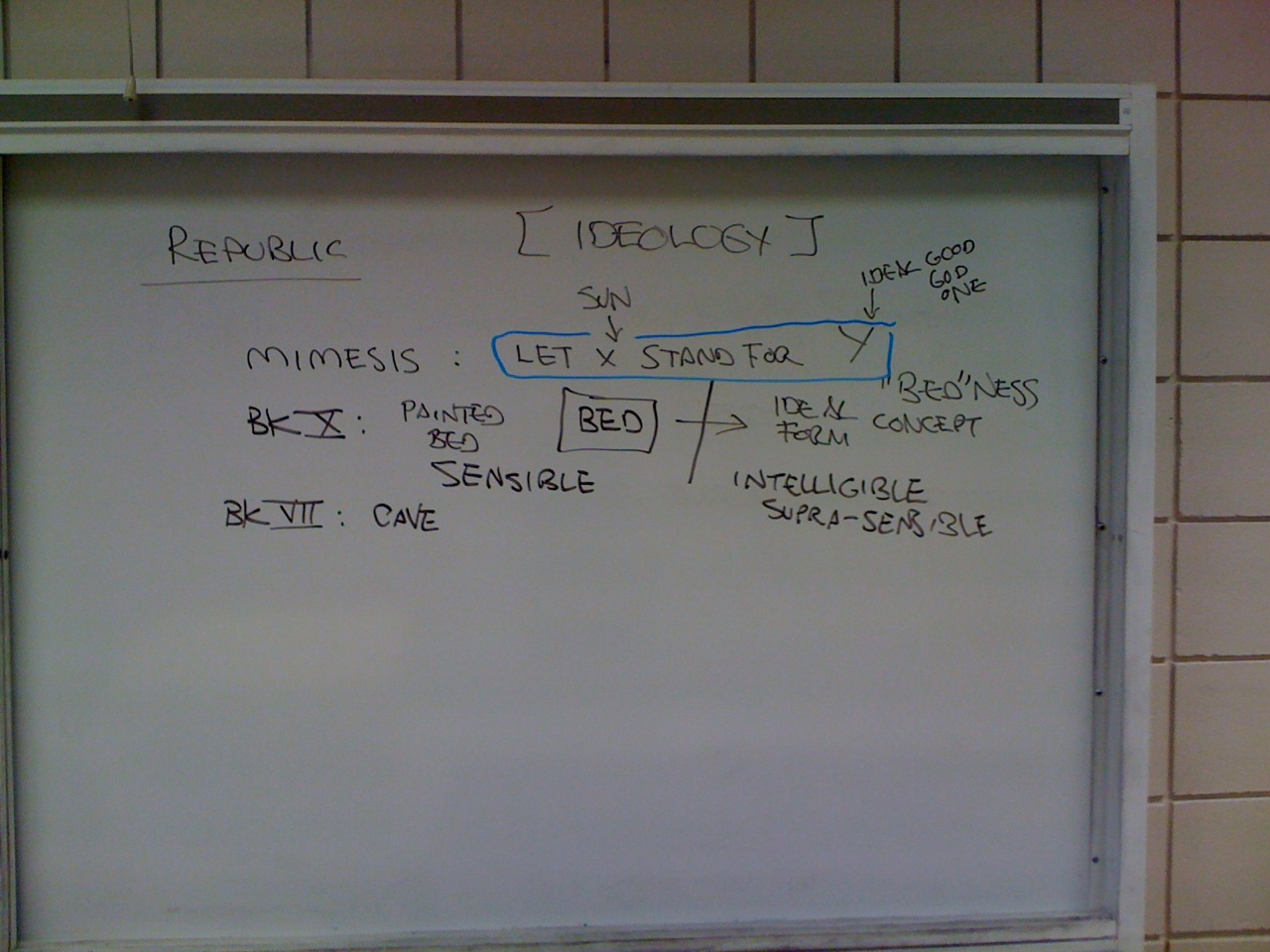
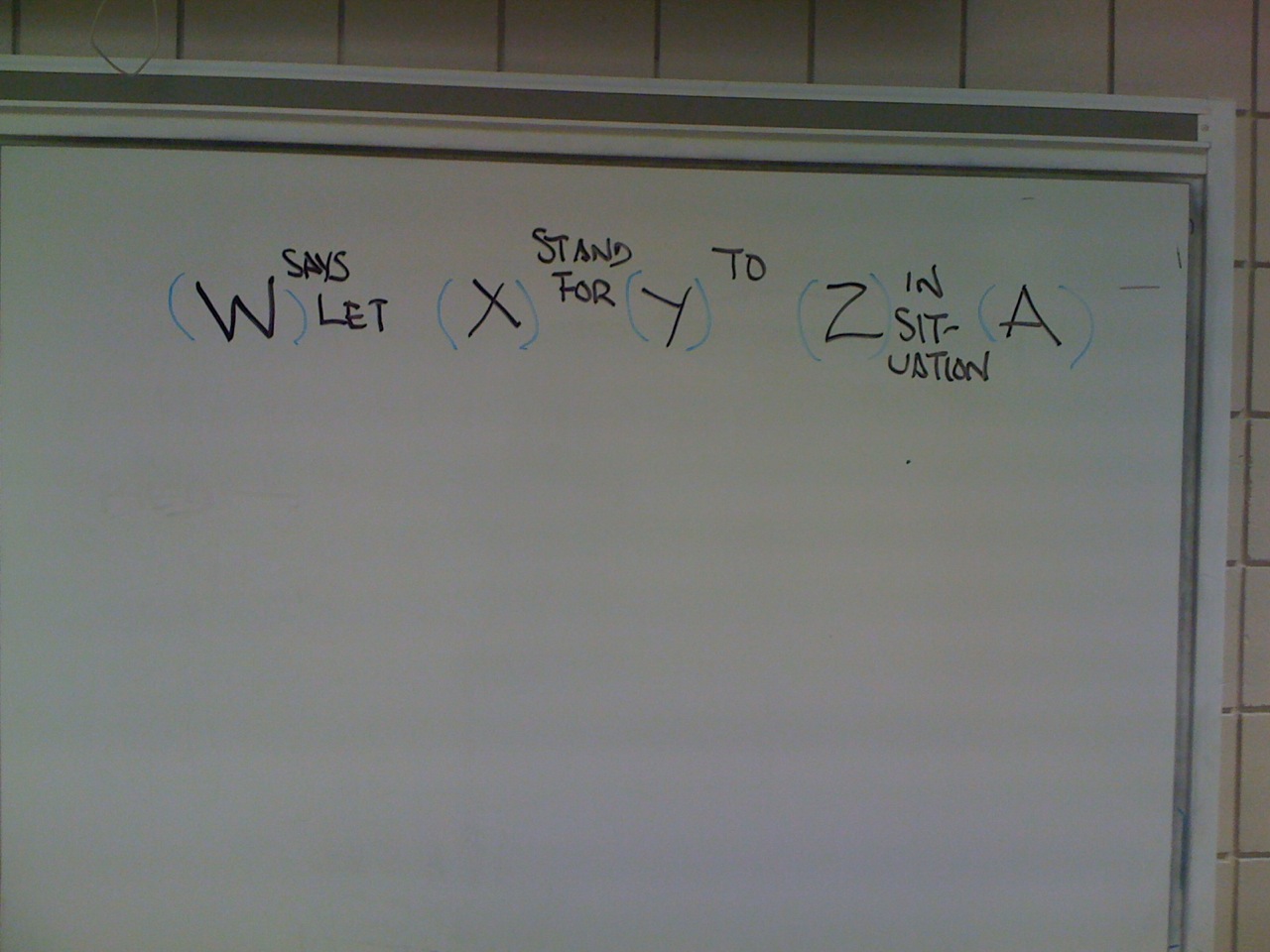
V. Elementary formula of semiotics: "Let x stand for y." The problem of mimesis, or representation (or—looked at from a certain angle, lying). A sign is anything you can use to lie with (Umberto Eco, badly paraphrased).
VI. What to look for in the "Ion." An arrogant, somewhat airheaded, pop star confronts the question: "What, if anything, do you actually know."
15 Jan | Plato, "Ion" (35-48; on-line). Proust 3-9.
I. In-class writing: In addition to the logical arguments advanced in Socrates's dialogue with the rhapsode Ion, there is also a prominently foregrounded, and rather complex, metaphor that factors into the conversation. What does Socrates mean when he speaks of the magnetic force & the iron rings?
II. Remarks on "Ion," and on Socratic method (or elenchus) more generally. Would you slip Socrates some hemlock?
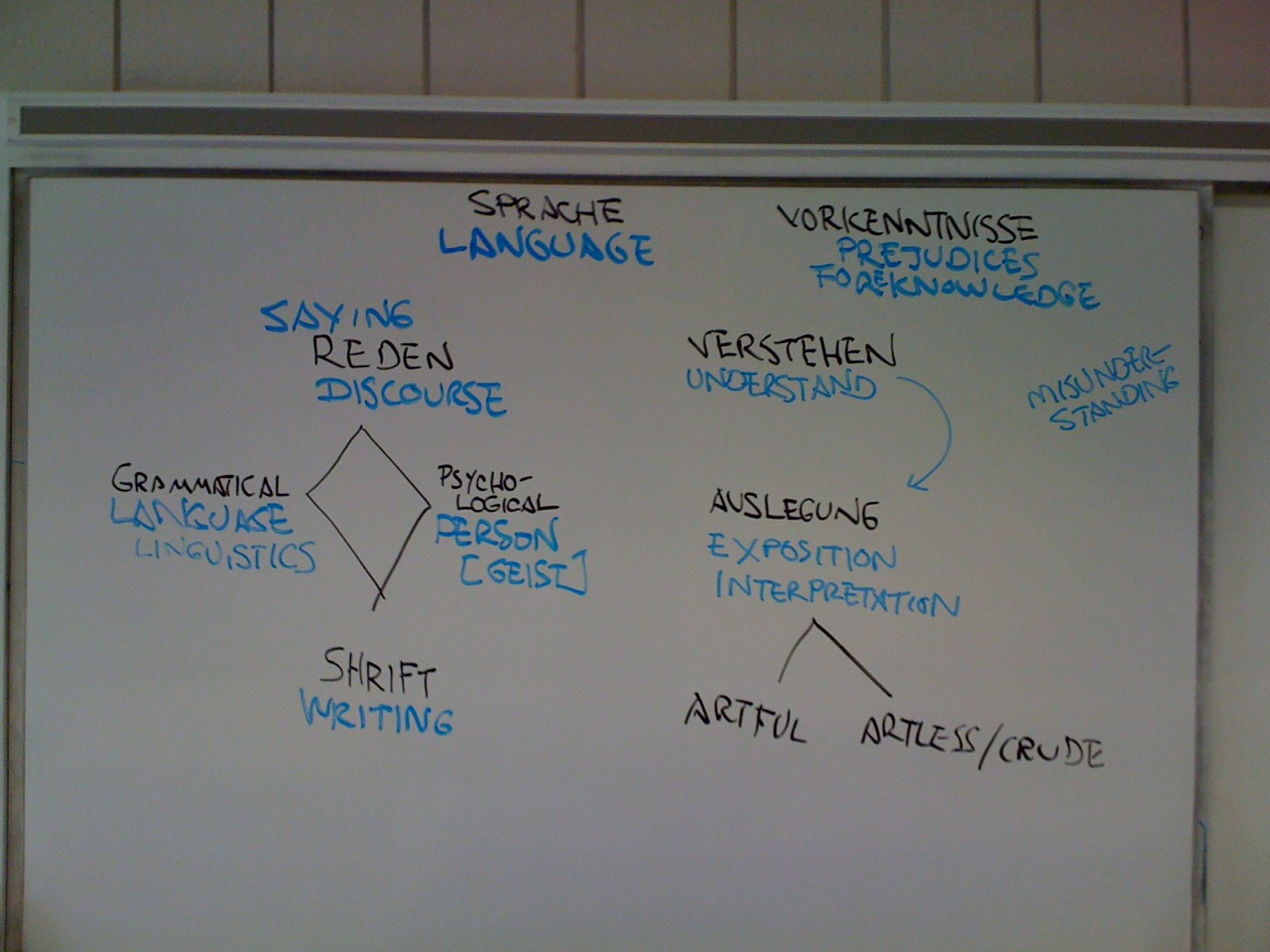
III. The hermeneutic circle. From part to whole, and back again; from manifest text to latent text, and back again.
IV. Remarks on Proust. "The Search for Lost Time" (À la recherche du temps perdu) vs. "Remembrance of Things Past." A task, its completion. Wasted time, spoiled time. "How not to have wasted one's life." Stéphane Heuet's graphic serialization (in French, as circulated in class; also in English).
week 2 - what is representation?
18 Jan | Martin Luther King Day - No Class
20 Jan | Norton: Plato, "Republic" (49-80, on-line). Proust 8-48. Plato Tip: If you're reading on-line, the Norton includes Book II paragraphs 376-83; Book III ¶¶ 386-92 and 400-403; Book VII ¶¶ 514-518; and Book X ¶¶ 595-608.
I. No reading check.
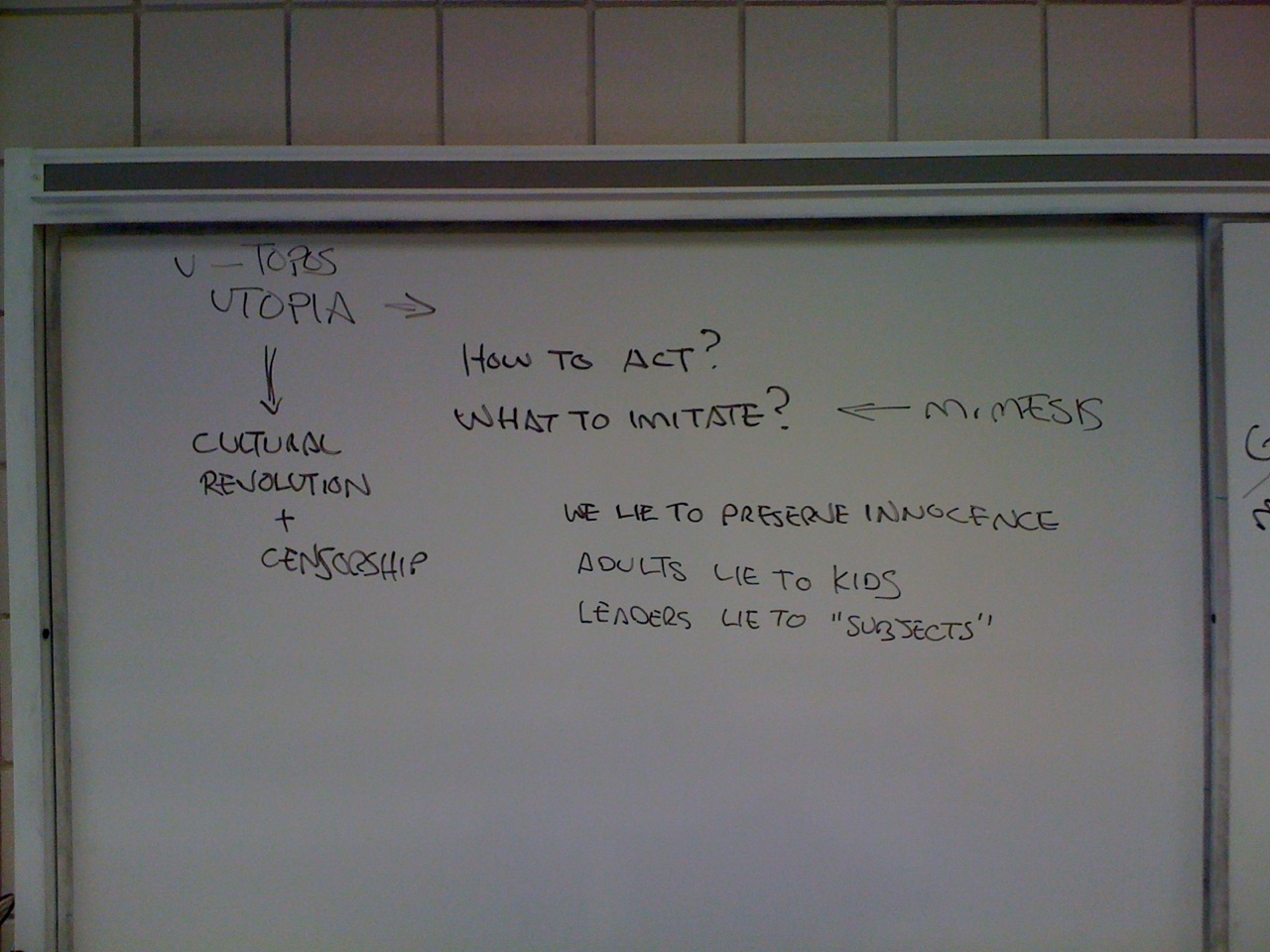
II. Plato's Republic. Utopic project of founding a good society (Books II-III). Whiteboard. Cultural revolution, education, and the necessity—or not—of lying to children.
III. Republic, Book X: three beds. Whiteboard. And the allegory of the cave (book VII).
22 Jan | Norton: Plato, "Republic" (49-80), "Phaedrus" (81-85).
I. In-class writing: Should mimesis be banned?
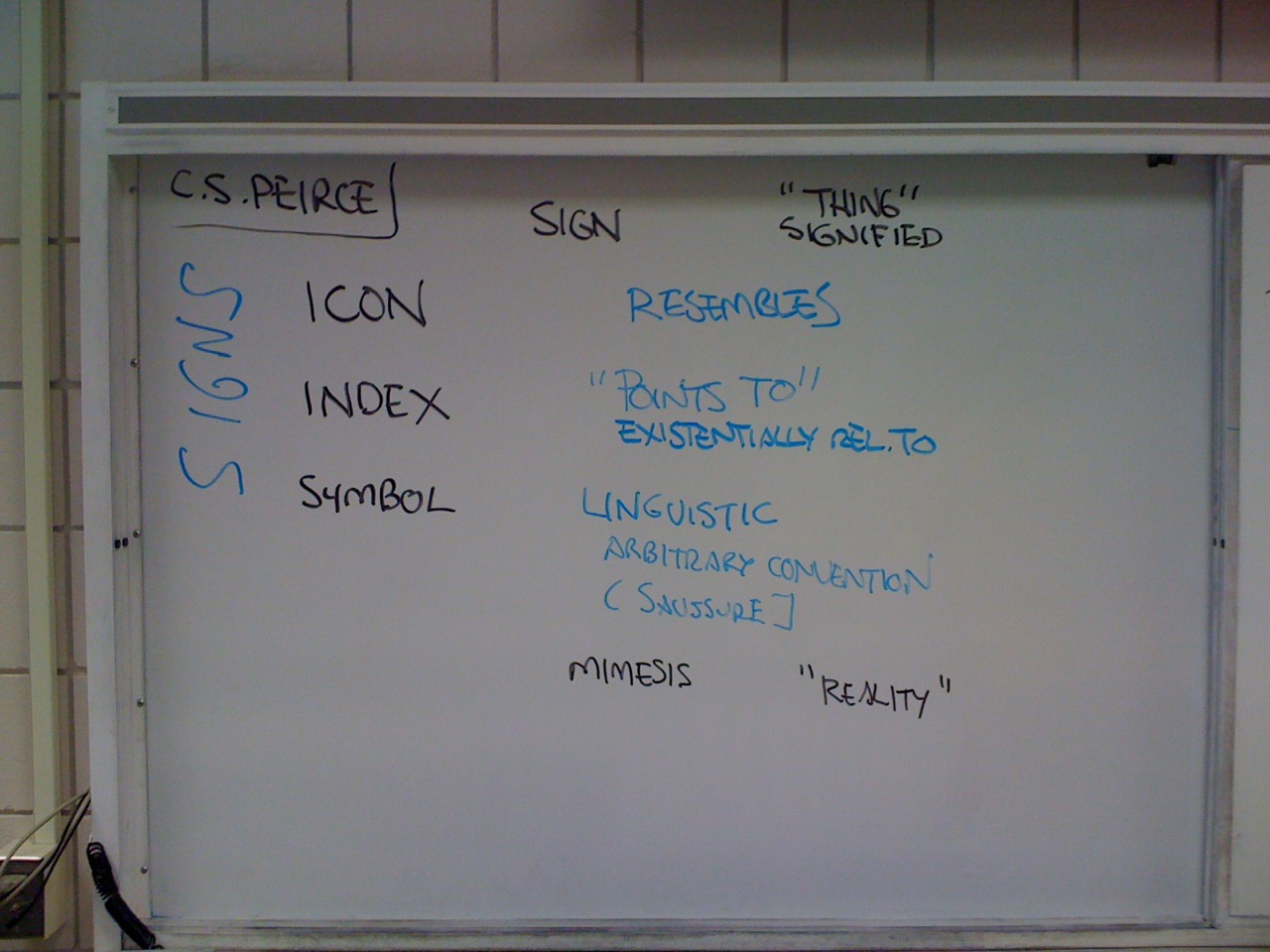
II. C.S. Peirce's tripartite categorization of signs: Icon, Index, Symbol. Whiteboard. Cf. Drew Huening's entry on the U of Chicago Theories of Media keywords glossary.
III. Discussion based on in-class writing: is it possible and desirable to eliminate mimesis from human practice?
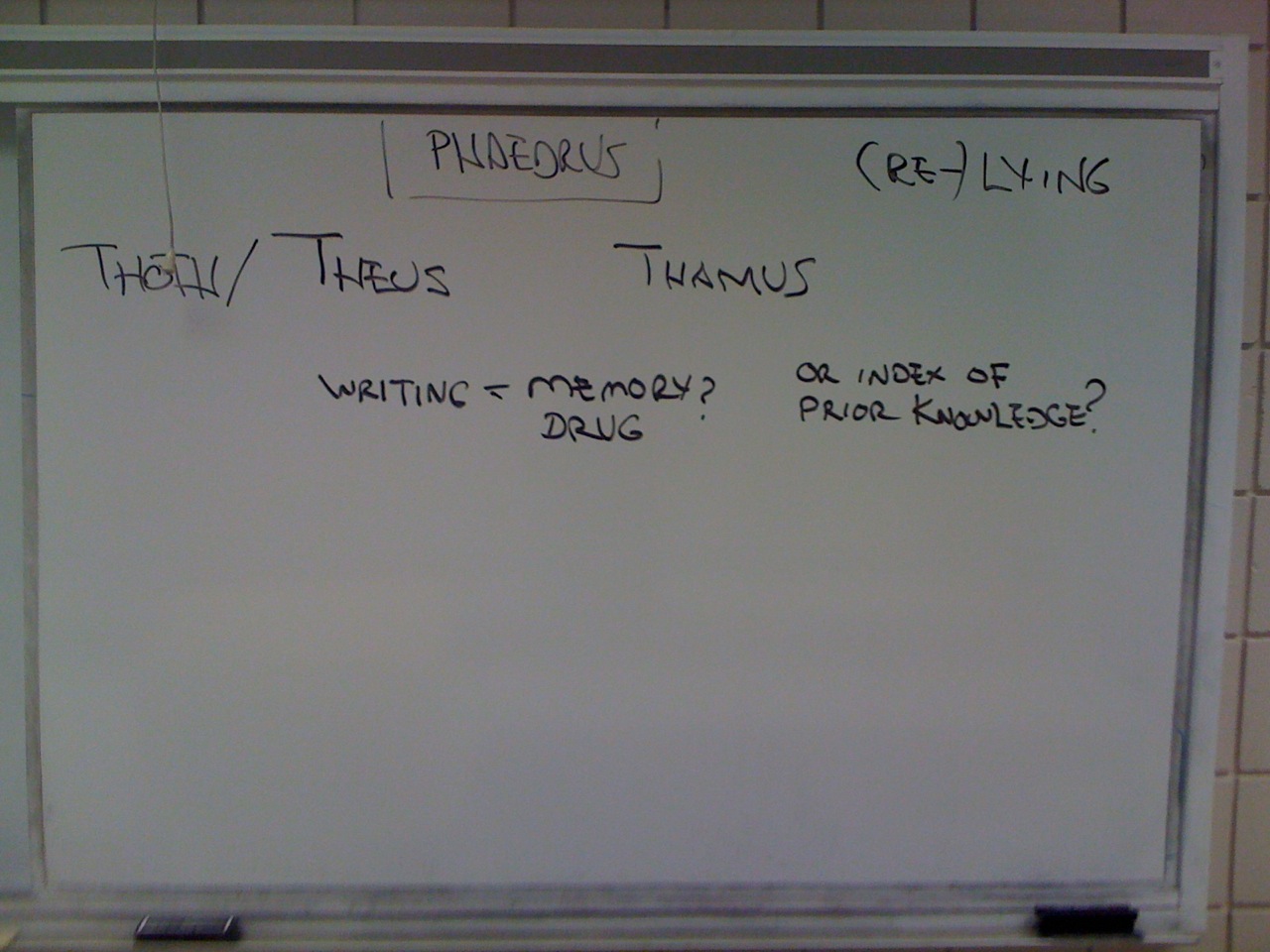
IV. The case for and against writing as a mimetic practice in Plato's Phaedrus. Whiteboard.
week 3 - what is representation?
25 Jan | Norton: Aristotle, "Poetics" (86-121). Proust 48-100.
I. Reading check: What made Saturdays exceptional in the narrator's family routine in Combray?
II. Discussion of Proust. Whiteboard.
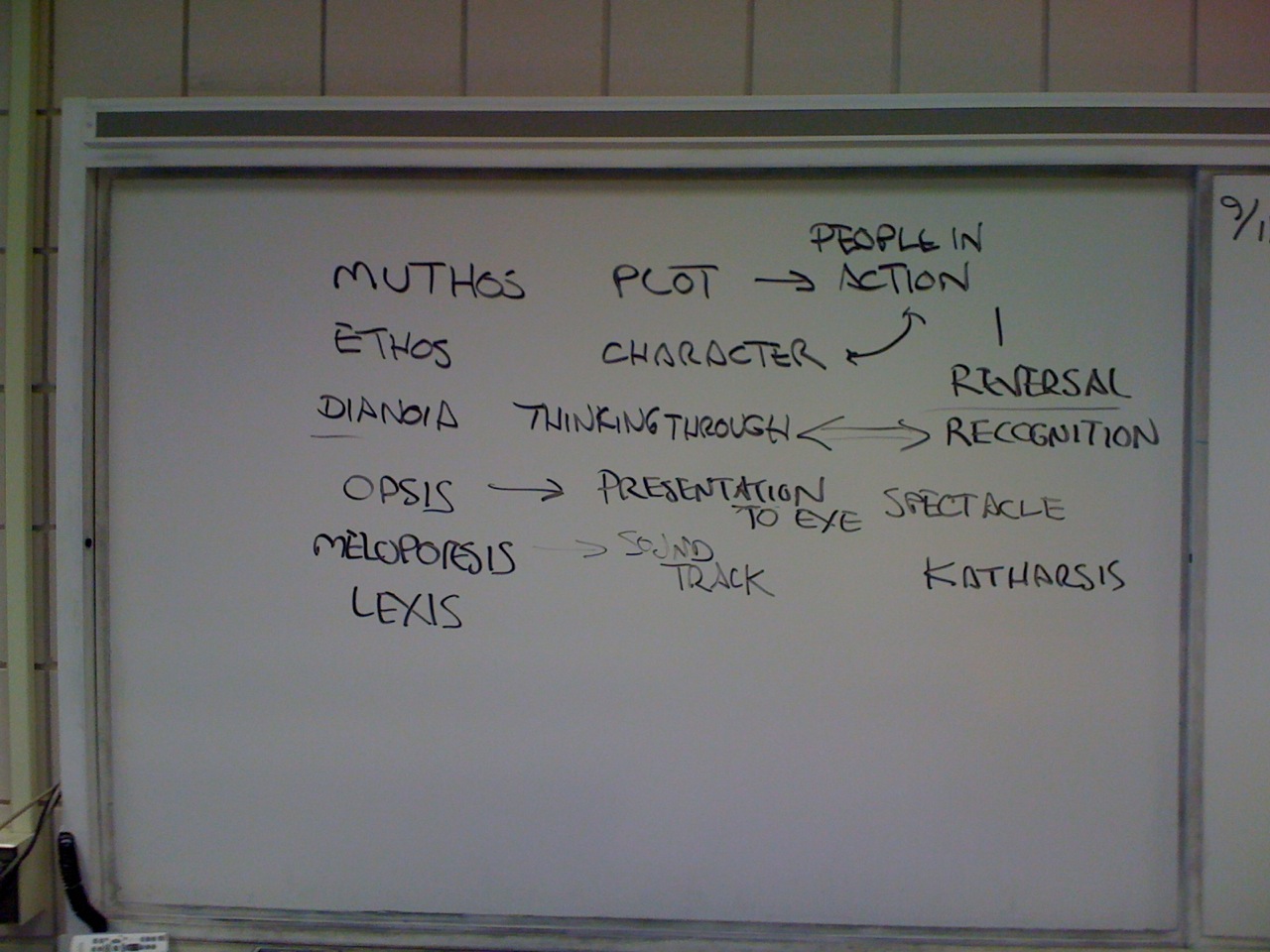
III. Five minutes for Aristotle (whiteboard): mimesis, or representation. The six elements common to tragic and epic narratives: plot (muthos), character (ethos), "thinking through" or reasoning (dianoia), spectacle (opsis), music or "soundtrack" (melopoeia: to make song), and "diction" (lexis, the language used by the various speakers and characters).
27 Jan | Norton: Aristotle, "Poetics" and "Rhetoric" (86-121). Proust 100-150.
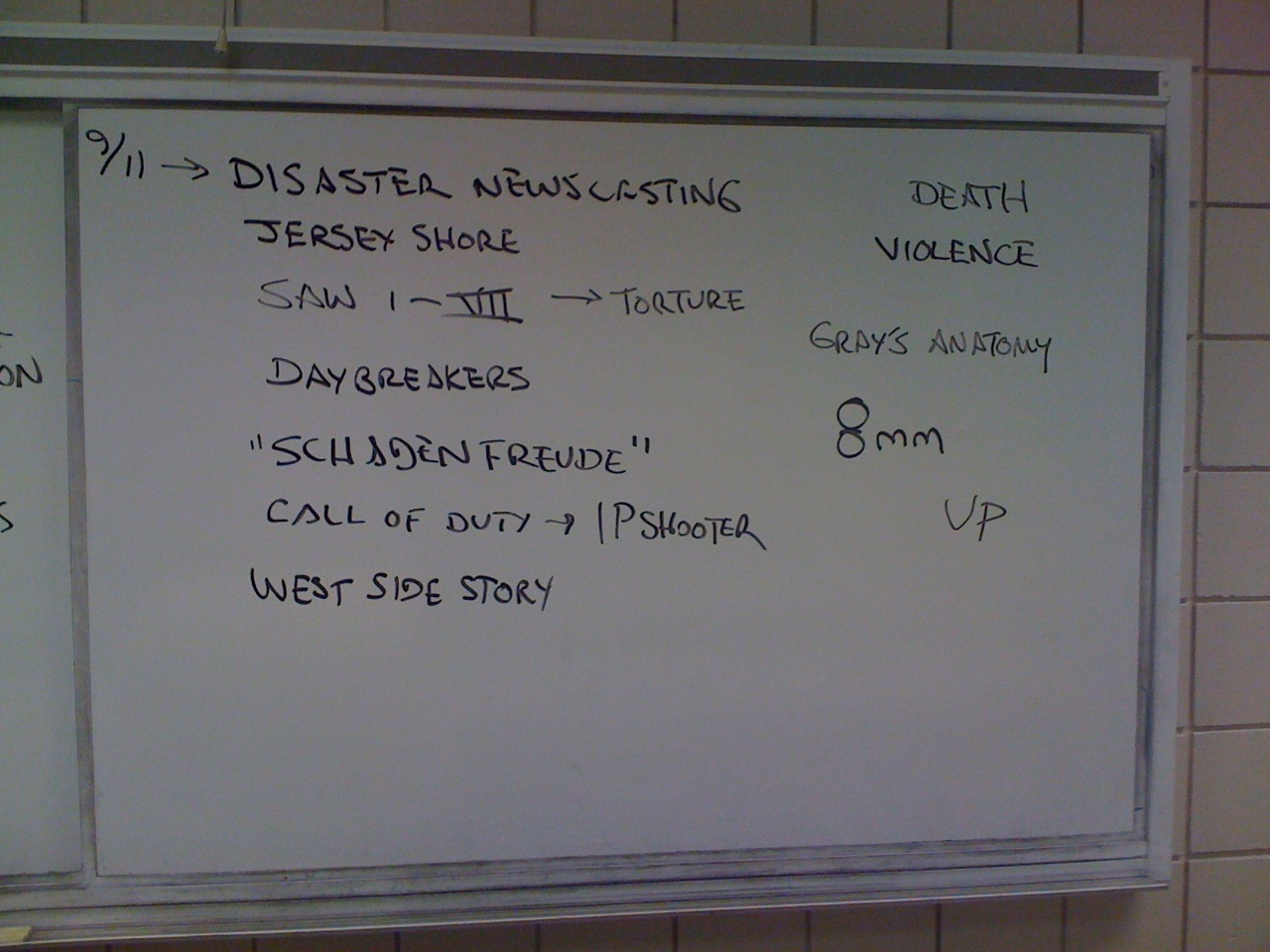
I. In-class writing: Aristotle claims that humans are not only inclined by nature to mimesis but that we delight in representations even of things and events that we would recoil from in "reality." Give an example or two from contemporary culture that bears out Aristotle's insight.
II. Discussion based on writing prompt. Whiteboard.
III. Aristotle's stance contrasted to Plato's. The latter, testing the truth and validity of phenomena. The former, seeking underlying structures beneath welter of surface complexity; a formalist of sorts.
IV. The six elements common to all tragic narratives: plot, character, reasoning (thinking-through), spectacle, music (soundtrack), and diction. Three other important features: reversal (peripeteia), recognition (anagnorisis), and catharis. Whiteboard.
V. Quick preview of Horace's "Ars Poetica," our focus on Friday.
29 Jan | Norton: Horace, "Ars Poetica" (121-135). Proust 150-200.
I. In-class writing: Given that Aristotle and Horace share a similar subject matter —what makes for excellence in literary art?—what differences in their approach and their arguments do you observe?
II. Review of Poetics.
III. Brief remarks on Aristotle's Rhetoric.
IV. Horace embodying the standpoint of the writer himself, in constrast to Aristotle (formalist critic) and Plato (seeker of truth, tester of validity).
week 4 - what is language?
1 Feb | Norton: Saussure (956-977). Proust 200-250.
I. In-class writing: Description of the narrative cultural object you are considering analyzing in your Aristotle paper.
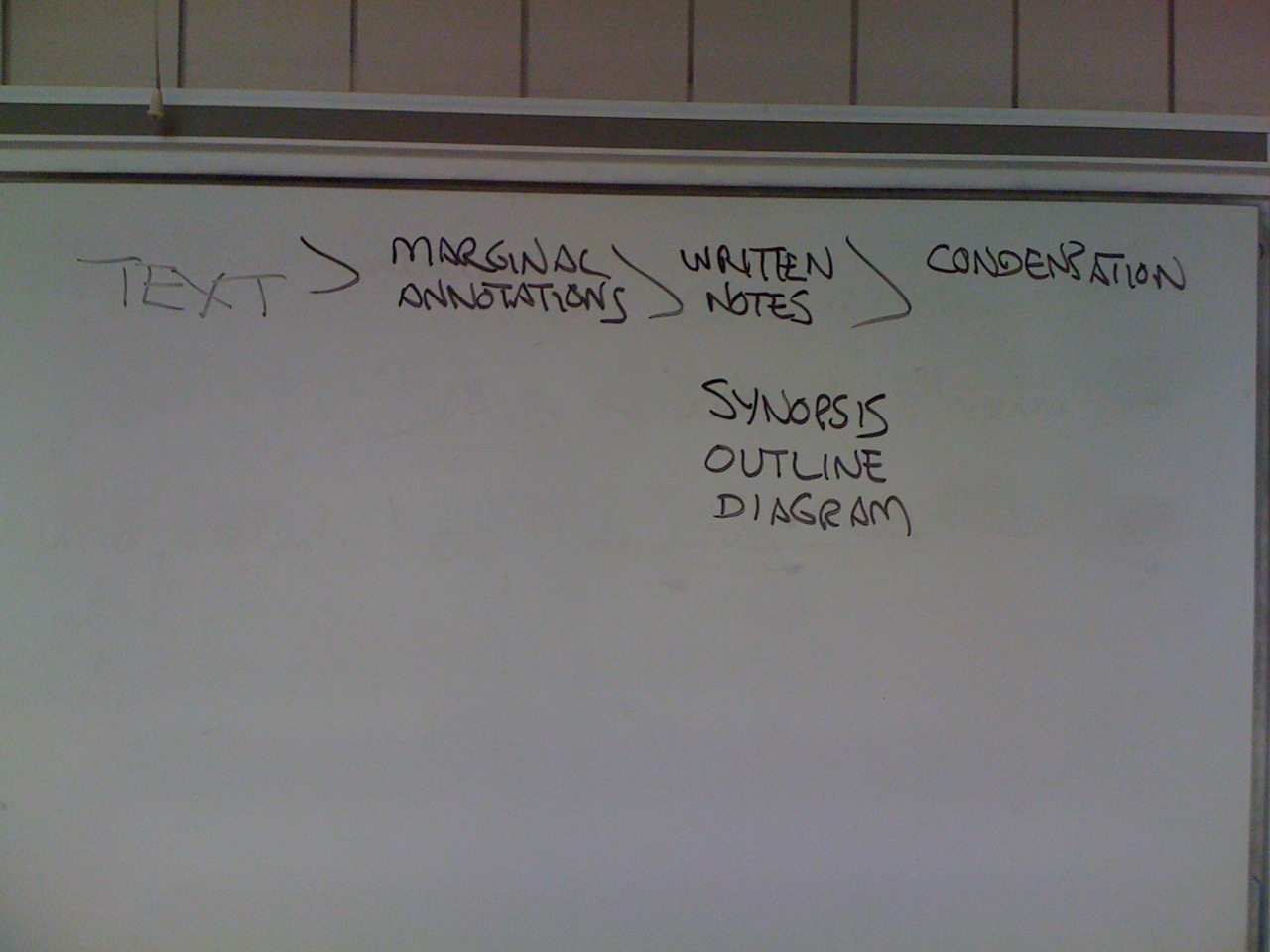
II. Strategies of active reading. Whiteboard. As one encounters denser, more difficult texts, one's reading practices need to evolve. Reading in "the brick."
III. W.J.T. Mitchell handout on "Representation." A good way to consolidate your thinking on the topic of "mimesis." Mitchell's account of Aristotle, and Peirce. His close reading of "My Last Duchess." Clever inversion of a historic slogan: "No representation without taxation." It'll cost you.
IV. Discussion based on writing prompt: what people are thinking to do their papers on.
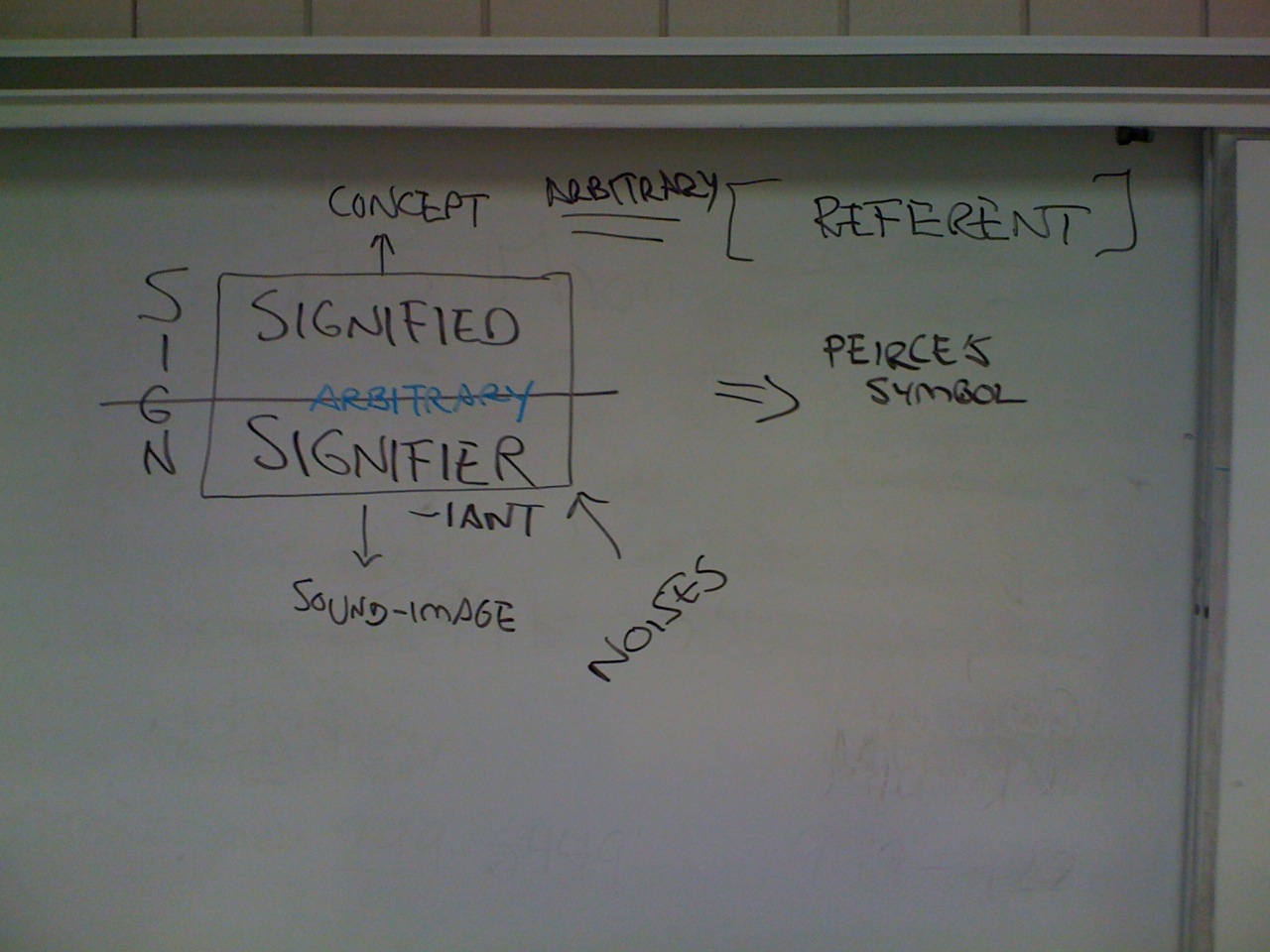
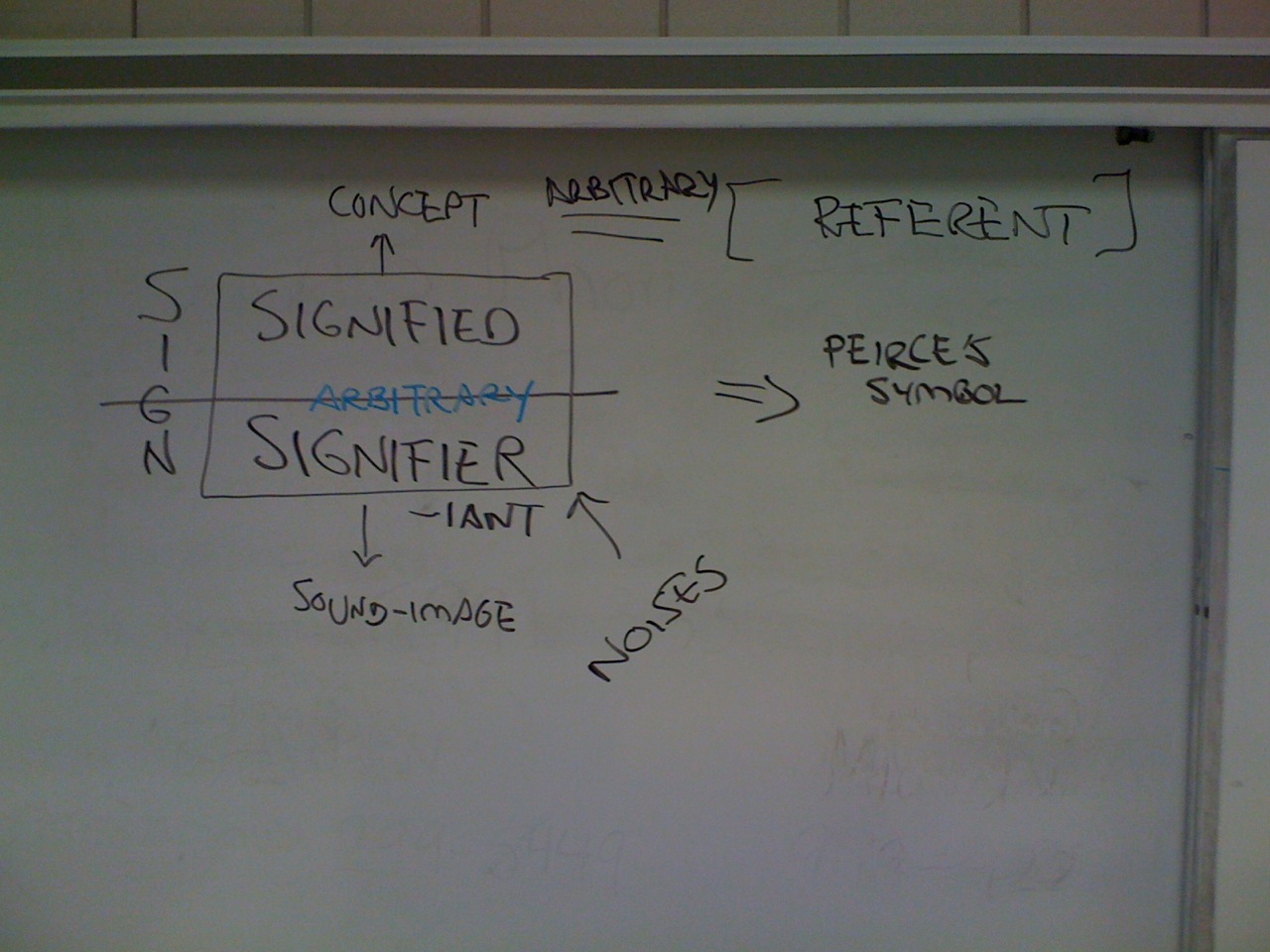
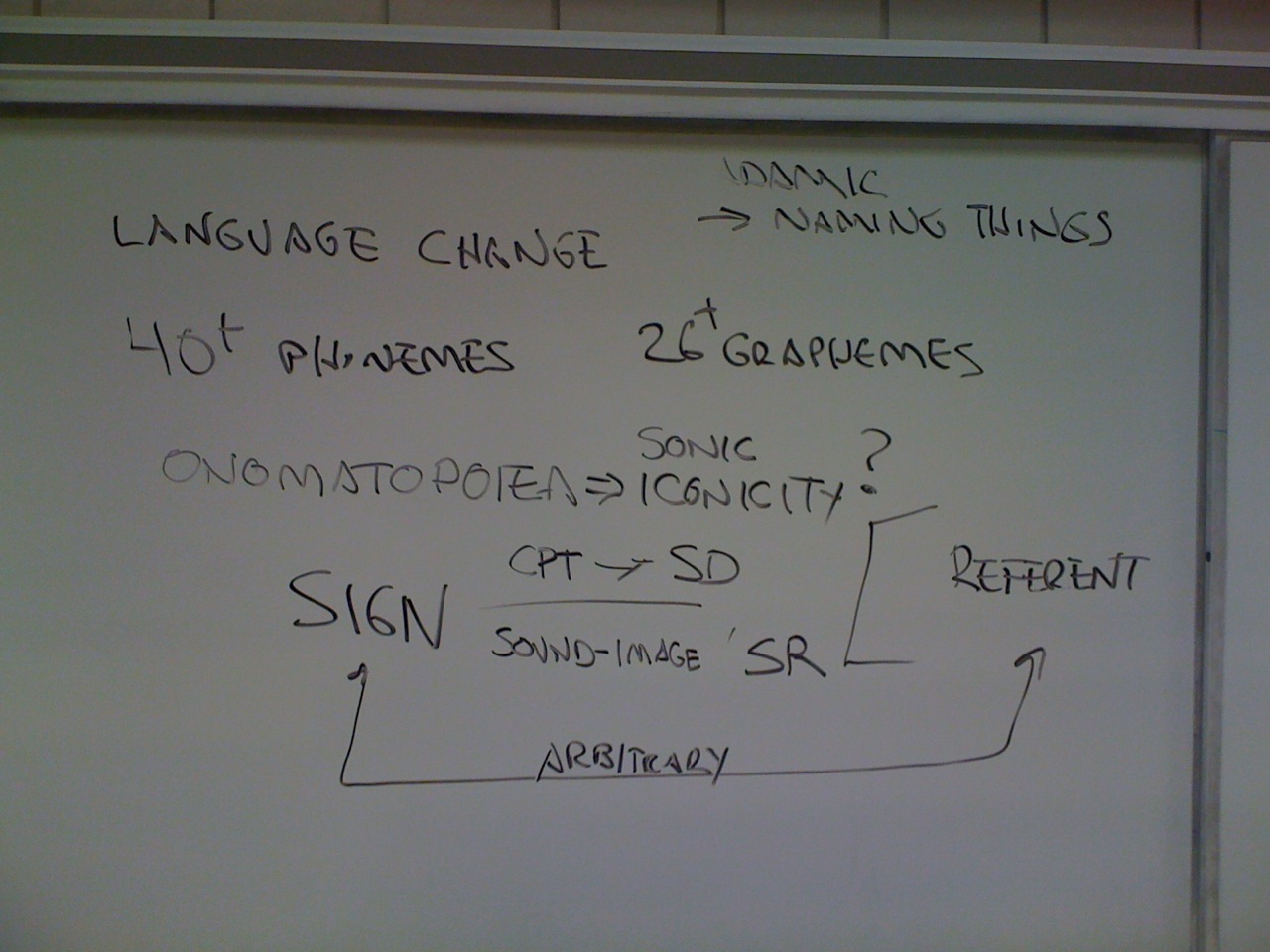
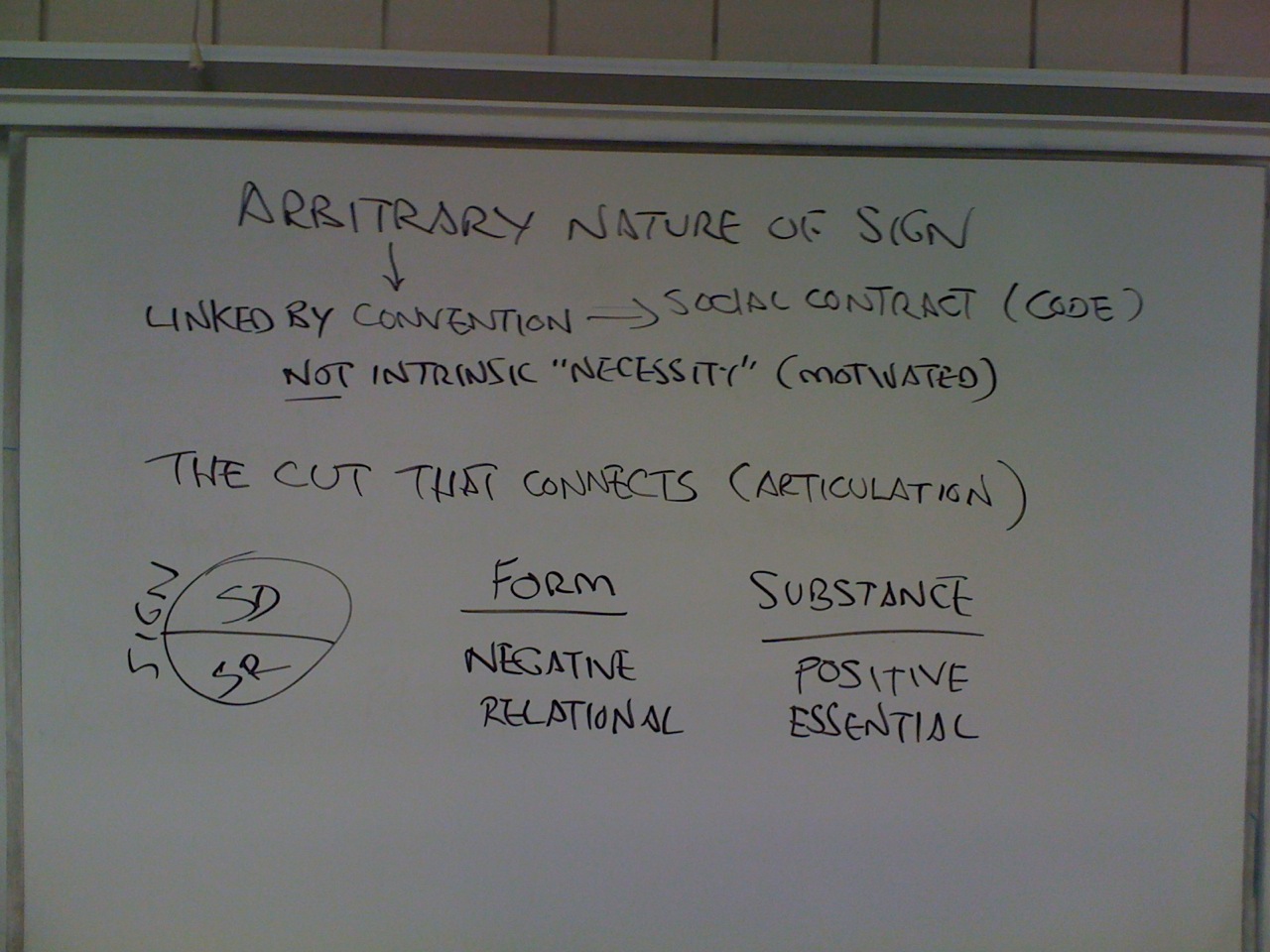
V. Saussure's definition of the linguistic sign as the union of a signifier (sound-image) and a signified (concept). Whiteboard. Two sides of a single sheet of paper. A slice of noise, a slice of meaning: phonemes = smallest meaningful unit of sound; grapheme = smallest meaningful mark. What Saussure means by "arbitrary." The signifier and signified are linked by arbitrary convention, and the sign is linked to a referent by arbitrary convention.
3 Feb | Norton: Saussure (956-977); Jakobson (1254-1269). Due in class: One sheet of notes on Aristotle's Poetics.
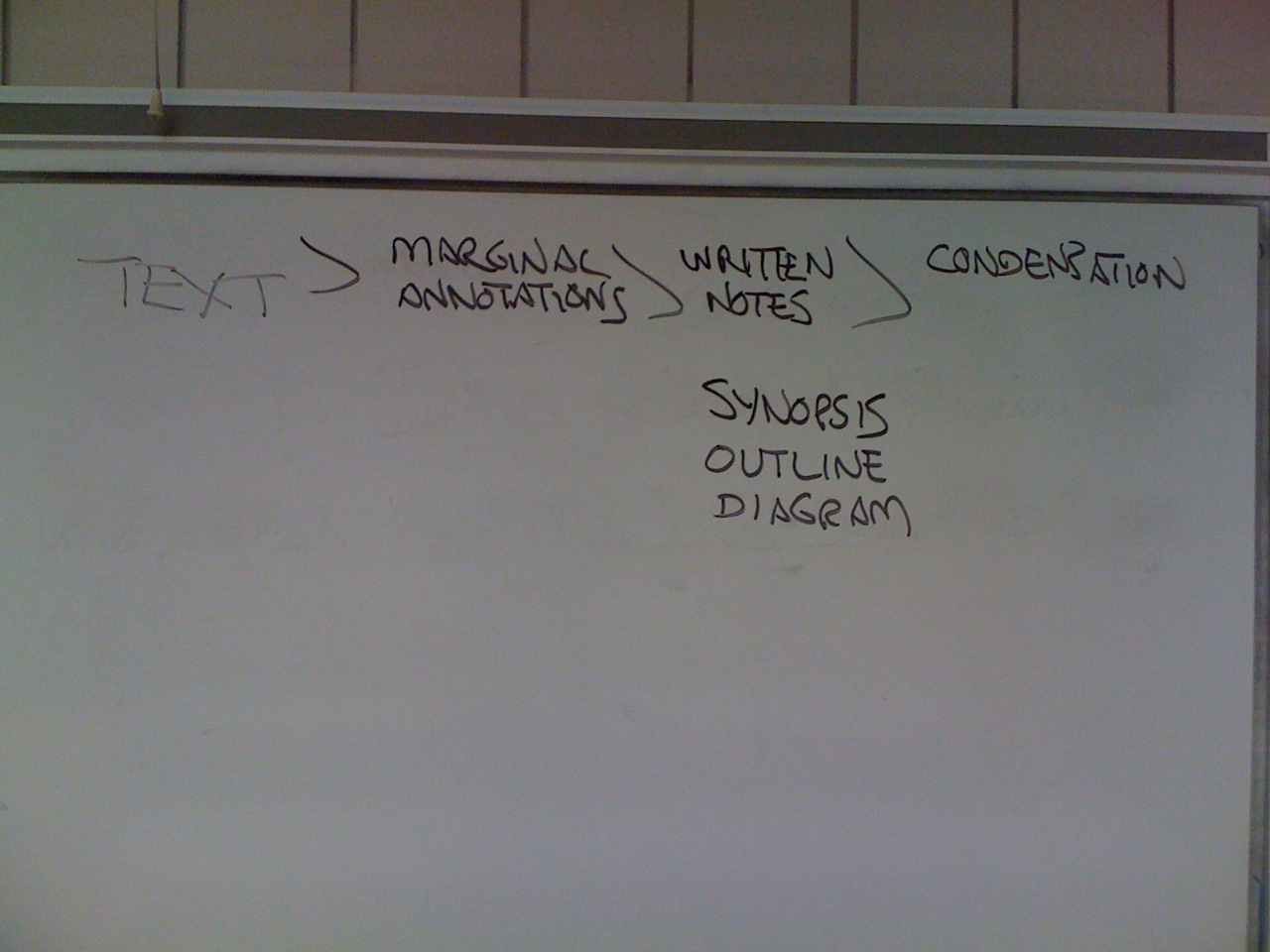
I. Remarks on annotation strategies. Practices of condensation. Whiteboard.
II. Saussure's definition of the sign (continued). Whiteboard.
5 Feb | Norton: Jakobson (1254-1269). Proust 250-300.
I. In-class writing: What does Saussure mean by "arbitrary" when he speaks of the arbitrary nature of the linguistic sign? Can you think of a category of signs in which the relationship is not arbitrary?
II. Saussure's definition of the sign. Whiteboard. Beyond the naive definition of language as "naming things."
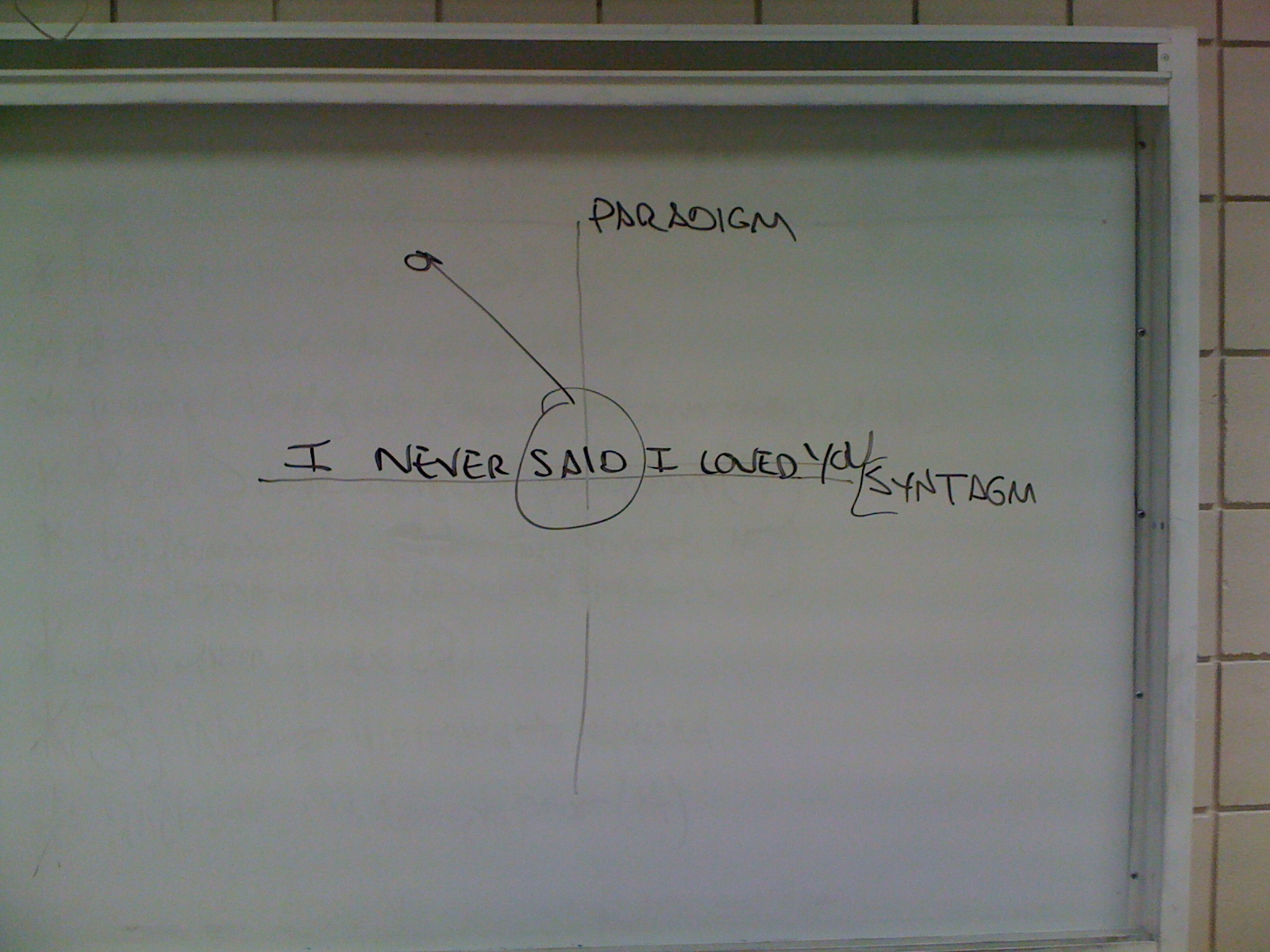
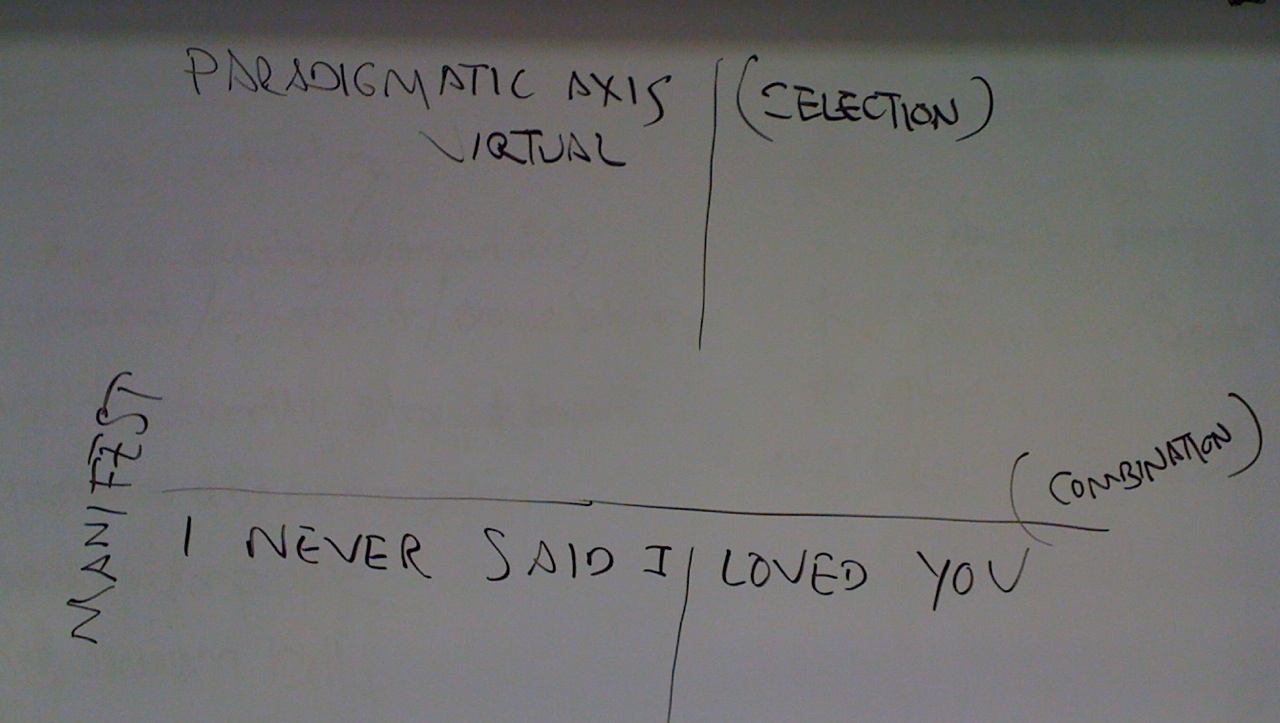
III. Paradigm and syntagm: lightning lecture. Whiteboard.
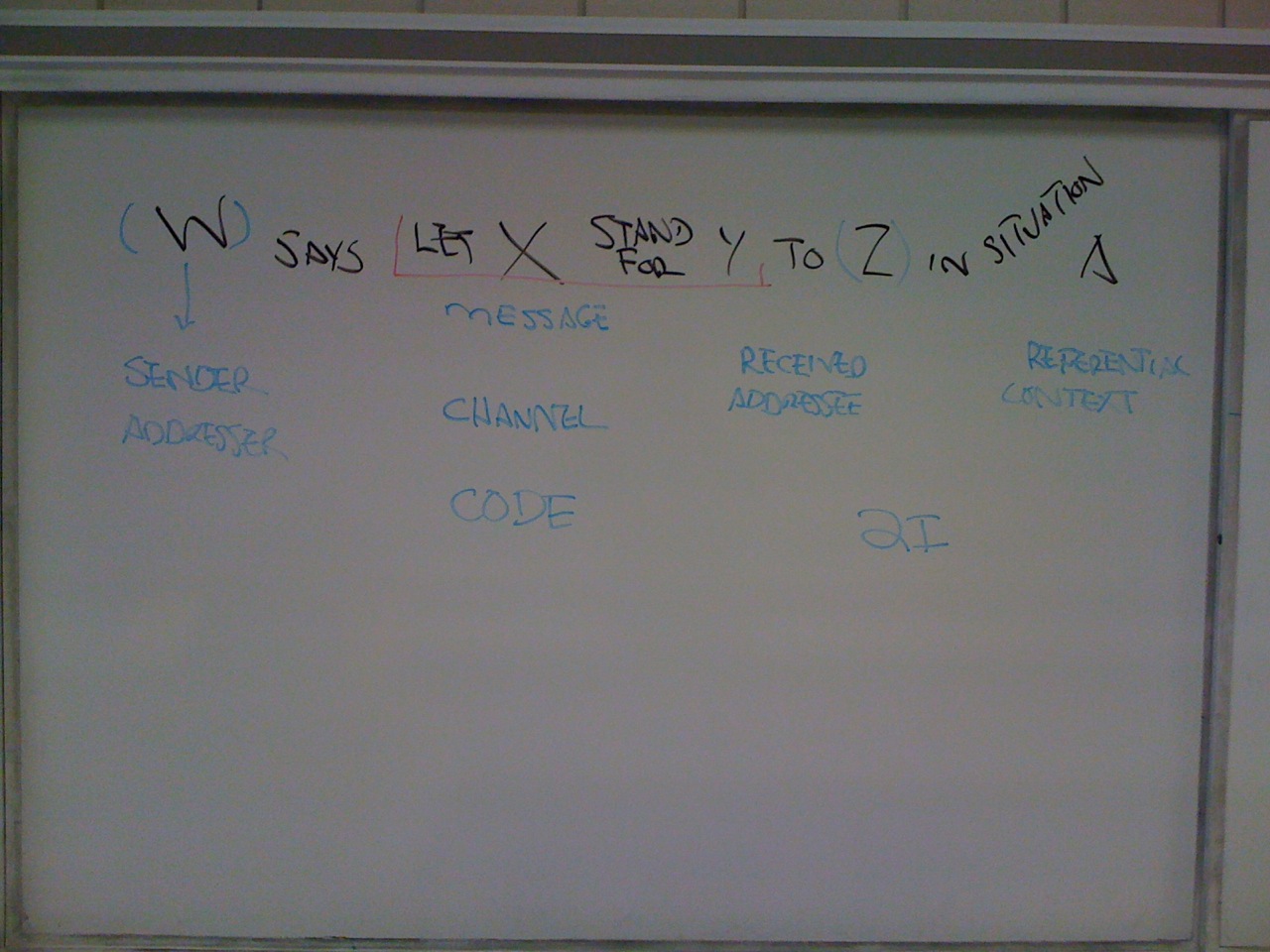
IV. Expanded formula for message exchange. Whiteboard.
week 5 - what is language?
8 Feb | Norton: Levi-Strauss (1415-1427). Proust 300-350.
A soundfile of this class session is available (49 MB).
I. Criteria for evaluation of Aristotle papers (circulated in class and discussed; also available as attachment to assignment circulated electronically).
II. Saussure review. Whiteboard.
III. Paradigm and syntagm (encore). Whiteboard. Using emphatic stress to "activate" the paradigm: I never said I loved you (though I hope we remain "bff"). The way the syntagm/paradigm distinction "scales": analogy to fractal patterns. Bundling: Phonemes > syllables > words > phrases > sentences > paragraphs > chapters > whole works > whole bodies of work > whole languages....
IV. Jakobson's "six functions" in relation to the "expanded" formula for communication. Whiteboard. W (addresser) says let X (sign) stand for Y (signification) to person Z (addressee) in situation A (context). Emotive and conative functions: set toward the speaker and the listener, respectively. The phatic function: do we share a channel? The metalinguistic function: do we share a code? Education as code construction and code repair.
10 Feb | Norton: Austin (1427-1442).
A soundfile of this class session is available (49 MB).
I. Jakobson's six functions (encore). With connecting remarks to Lévi-Stauss's claim that writing was invented to facilitate slavery and Austin's discussion of "performative utterances."
12 Feb | Norton: Heidegger (1118-1135). Proust 350-400.
A soundfile of this class session is available.
week 6 - what is hermeneutics? what makes an interpretation valid?
15 Feb | Norton: Schleiermacher (610-626). Proust 400-444. Aristotle Paper due electronically before class.
A soundfile of this class session is available.
I. In-class writing: The Amazing True Story of the Genesis of Your Magnificent Aristotle paper.
II. Heidegger, encore.
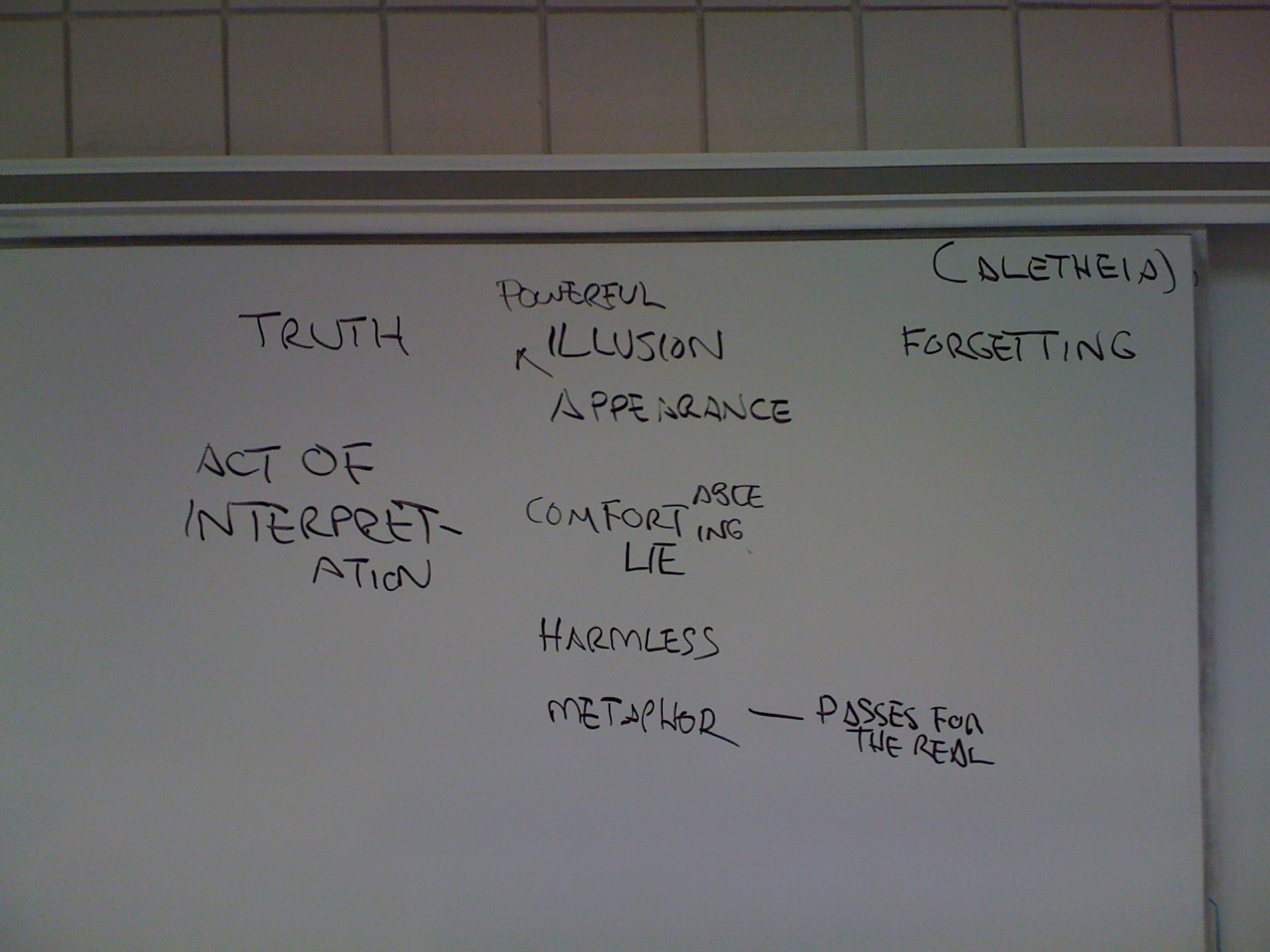
17 Feb | Norton: Nietzsche, "On Truth and Lying..." (870-884).
A soundfile of this class session is available.
I. In-class writing: some passages from Schleiermacher and Nietzsche that warrant discussion.
II. Remarks on Schleiermacher's treatise on "Hermeneutics." Whiteboard.
III. Proust Assignment: Select three scenes of message exchange from parts two and three of Swann's Way (i.e. "Swann in Love" and "Place-Names: The Name"). For each scene, identify the constituent elements of the exchange using the formula "W says let X stand for Y to Z in situation A" and describe the message's fate (interpreted as intended, interpreted in a manner other than intended, misinterpreted, unheeded, happy/unhappy, etc.). Responses that connect the scenes to aspects of Jakobson and Austin's respective theories of speech acts will be smiled upon. A paragraph for each scene should do. Submit your assignment as a First Class e-mail to Steve before class on Wednesday, February 24.
19 Feb | Norton: Poulet (1317-1333).
A soundfile of this class session is available.
I. Presentation by Molly Schenck (Advising Intern) and Andrew Dunn (English Student Advisory Board) on resources for advising.
II. Nietzsche's response to the question, "What is truth?" In brief, the most powerful act of interpretation. Whiteboard.
week 7 - what is hermeneutics? what makes an interpretation valid?
22 Feb | Norton: Iser (1670-1682). Freud, Interpretation of Dreams, chap. 2.
I. Remarks on Poulet and the act of reading.
24 Feb | Norton: Jauss (1547-1565). Freud, Interpretation of Dreams, chap. 3.
A soundfile of this class session is available.
I. Proust assignments collected; no in-class writing.
II. The five canonical narrative tempos: ellipsis (no plot, some story); summary (plot < story); scene (plot = story); stretch (plot > story); and pause (some plot, no story).
III. Discussing scenes of message exchange in Proust, using the tempos. "Our song."
IV. Wolfgang Iser on blanks and gaps, foreground and background, the wandering perspective of the reader.
26 Feb | Freud, Interpretation of Dreams, chap. 4.
A soundfile of this class session is available.
I. In-class writing: Preconceptions we bring to the reading of Freud.
II. An introduction to psychoanalysis and the Interpretation of Dreams.
week 8 - what is hermeneutics? what makes an interpretation valid?
15 Mar | No Class (Professor Evans in NYC to give a talk). Wimsatt & Beardsley, "The Intentional Fallacy" (1371-87). Freud, Interpretation of Dreams, chap. 5.
17 Mar | Norton: Eichenbaum (1058-1087)
A soundfile of this class session is available.
I. Wimsatt and Beardsley's claim that it is neither possible nor desirable to retrieve an author's "intention" from his or her text.
19 Mar | Norton: de Man, "Semiology and Rhetoric" (1509-1526). Freud, Interpretation of Dreams, chap. 5.
A soundfile of this class session is available.
I. Freud's Interpretation of Dreams. The basic "formula": a dream is the fulfilment of a wish. Expanded in chapter four: a dream is a (disguised) fulfilment of a (suppressed or repressed) wish.
week 9 - what is an author?
22 Mar | Norton: Gramsci (1135-1144). Freud, Interpretation of Dreams, chap. 6.
A soundfile of this class session is available.
I. Paul de Man's reading of Proust's scene of reading, a close reading of Norton 1522-23. Literal, figurative (or figural), and meta-figural valences. Does Proust's text "practice what it preaches"?
24 Mar | Norton: Sartre (1333-1350).
A soundfile of this class session is available.
I. Gramsci on the formation of intellectuals. Division of labor: manual, mental. Education's role in the reproduction of the economic system. Organic vs. traditional intellectuals. Organic to a movement, moment, or situation. The struggle to produce and circulate ideas. Hegemony (securing "spontaneous" consent) vs. repression (the state's monopoly on the legitimate use of violence).
II. Freud on the sources of dreams (chapter 5). Recent & indifferent materials from the dream-day; infantile or childhood materials, perhaps repressed or previously forgotten; somatic (or bodily) sources.
III. The section on "Typical Dreams" contains the famous discussion of Oedipus Rex and Hamlet (260-66).
26 Mar | Norton: Barthes (1466-1470), Foucault (1622-1636). Freud, Interpretation of Dreams, chap. 6.
A soundfile of this class session is available.
I. The Academic Program Prioritization Working Group's recommendations and their impact on education at UMaine.
II. Freud on the sources of dreams (review from Wednesday and continued discussion).
week 10 - what is an author?
29 Mar | Norton: Bakhtin (1186-1220). Freud, "The Uncanny" (929-52).
A soundfile of this class session is available.
I. Remarks on Aristotle papers.
II. Freud's sketch of the "dream-work" (chapter VI). Condensation, displacement, and the means of representation (sections a-c).
31 Mar | Norton: Gilbert & Gubar (2023-2035). Freud, "The Uncanny" (929-52).
A soundfile of this class session is available.
Forecast: Brief remarks on Sartre's notion of the reader's "freedom" (cf. March 24 above), then a focus on Barthes and Foucault.
I. The "author" and "authority," the reader's "response" and "responsibility."
2 Apr | Norton: Ngugi, Liyong, and Owuor-Anyumba (2089-2097).
Due to a technical difficulty, no soundfile of this class session is available.
Forecast: Remarks on Gilbert & Gubar (cf. March 31), followed by consideration of Ngugi, Liyong, and Owuor-Anyumba.
I. In-class writing: Your position on the following motion, "inspired" by Ngugi et al. and the current cuts proposed here at UMaine: The English Department should be abolished—yay or nay? If yay, what should replace it? If nay, why not?
II. The minority report. Versions of the majority standpoint. What an English Department does do, might do, can't do, etc.
week 11 - what is ideology? identities and interpretations in conflict
5 Apr | Norton: Hegel, "The Master Slave Dialectic" (630-36).
Forecast: Discussion of Freud's "The Uncanny," and lecture on Hegel's "master/slave dialectic." Questions about papers entertained.
I. Foucault on the "author-function" and "initiators of discursive practices."
II. Brief remarks on Hegel's "master/slave dialectic."
7 Apr | Norton: Marx & Engels (759-789).
Forecast: Questions about Freud in advance of paper due April 12. Hegel, Marx-Engels.
9 Apr | Lacan, "The Mirror Stage..." (required) and "from The Agency of the Letter..." (recommended) (1278-1302).
Forecast: Remarks on Hegel & Marx.
week 12 - what is ideology? identities and interpretations in conflict
12 Apr | Norton: Althusser, "from Ideology and Ideological State Apparatuses" (1483-1509). Freud Paper due in electronic form by 10:30am.
Forecast: Remarks on Lacan's "Mirror Stage" and Althusser.
14 Apr | No Class! Norton: Jameson (1932-1975).
16 Apr | Norton: Wollstonecraft (582-94); de Staël, "On Women Writers" (604-610).
Forecast: Remarks on Althusser & Jameson (theories of ideology), introduction of Wollstonecraft & de Staël (examination of patriarchy as particular form of ideology).
week 13 - what is ideology? identities and interpretations in conflict
19 Apr | Norton: Woolf (1017-1030); Hurston (1159-1162).
Forecast: My remarks will cover Friday's reading assignment (Wollstonecraft & de Staël) as well as today's.
21 Apr | Norton: de Beauvoir (1403-1415); Wittig (2014-21).
23 Apr | Norton: Rich (1759-1781).
week 14 - what is ideology? identities and interpretations in conflict
26 Apr | Norton: Spivak (2193-2208).
28 Apr | Maine Day - No Class
30 Apr | Norton: Haraway (2266-2299).
finals week
Monday, May 3, 10:30am-12:30pm (Finals Period A2)
Cumulative Final Exam
|